Cruise Day 6: Island of Rhodes, St Paul’s Bay, Colossus and Thunderstorm
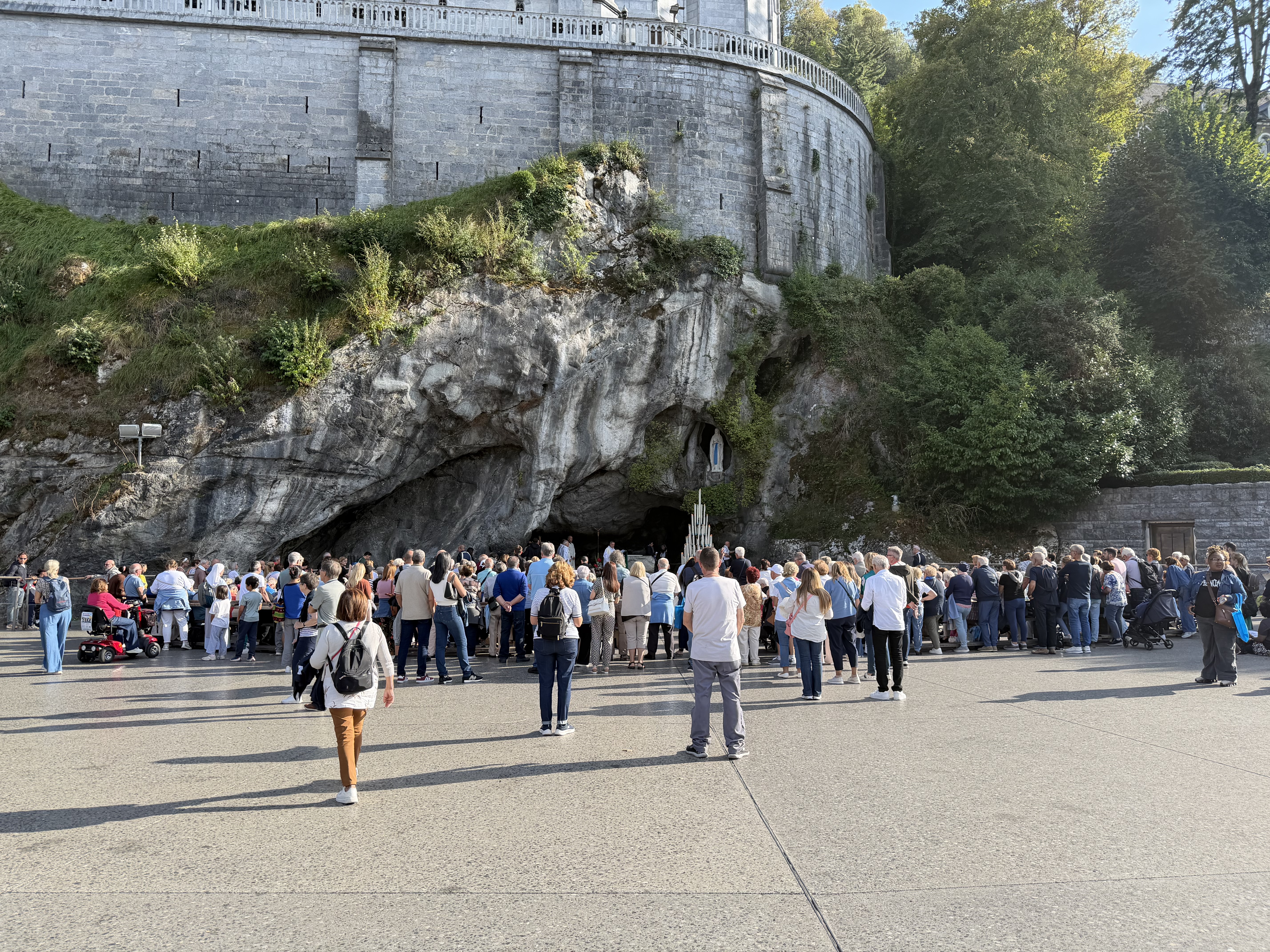
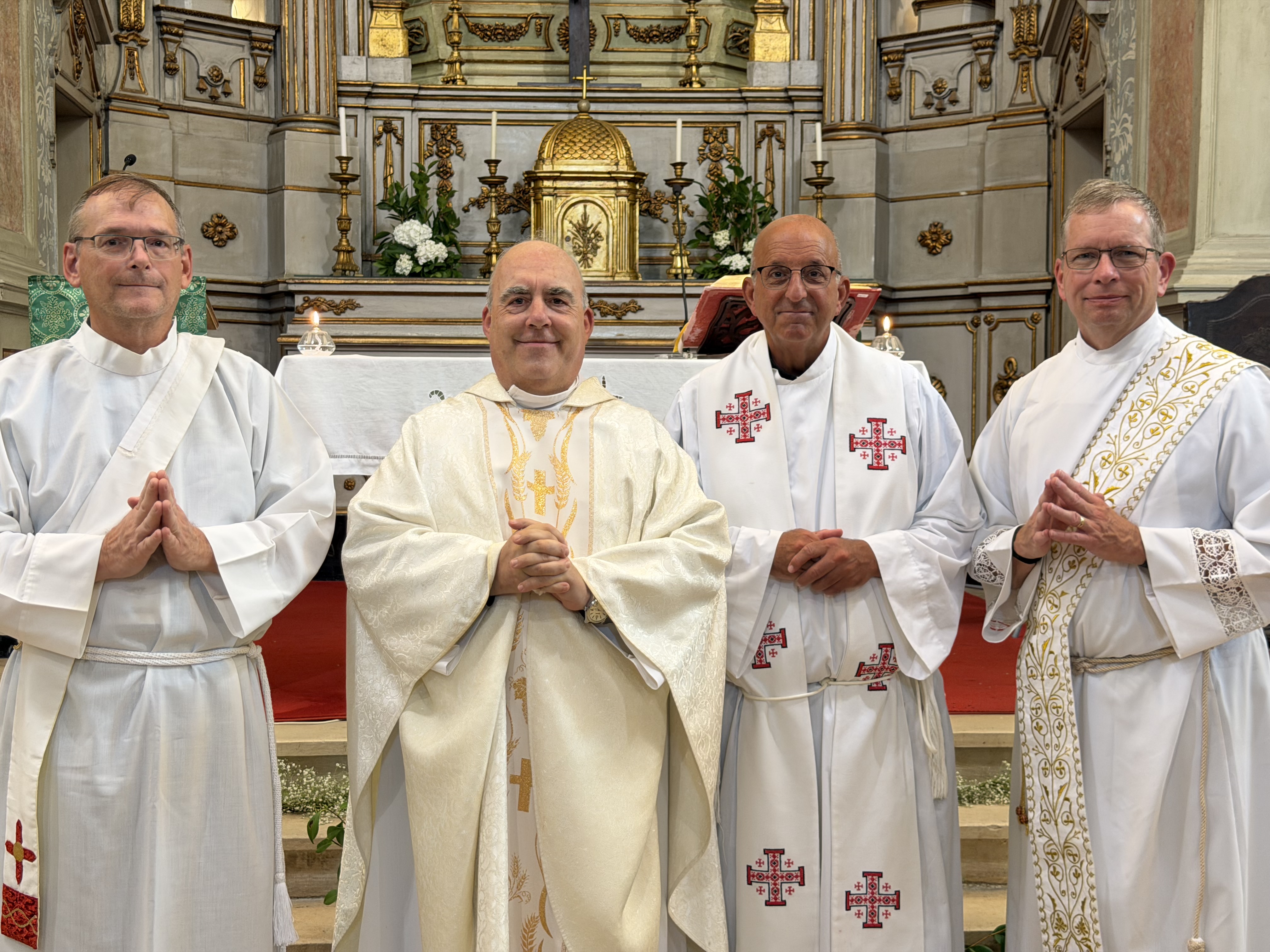
Early start, early ending. Celebrated Mass at Franciscan’s Santa Maria Catholic Church, one of only two on the island even though Rhodes is the 4th largest Greek Island.
Informative drive with the guides giving us the history and culture of the island as we drove to St. Paul’s Bay in the Lindos area where St. Paul’s ship madea short stop on his way to Jerusalem. Steve gave a short talk at Mass to explain the biblical importance of roads, which is minimal actually.
It seems that Paul’s ship probably docked in the bay overnight before it left again. But it’s always enchanting to stand there thinking of Paul pulling into that bay on a Roman ship full of soldiers and sailors.
We drove back to Rhodes City with the intention of taking a tour of the old city and giving people free time for lunch and shopping. But a thunderstorm overshadowed us and dumped on us big time, so we were walking through rivers of water in the cobblestone streets and got to the buses soaking wet and ended up drying off and eating lunch on the ship and enjoying a free afternoon and evening.
Should Catholics Attend Non-denominational or Ecumenical Bible Studies?
Every day, Catholics are invited by coworkers, neighbors, and even family members to “ecumenical” Bible studies. Should they go? Certainly all of us would benefit from more study of Scripture, but as someone who has been a part of a number of Protestant Bible studies—I’ve even taught them—I discourage Catholics from attending them because of the foundational premises and principles in operation at these studies.
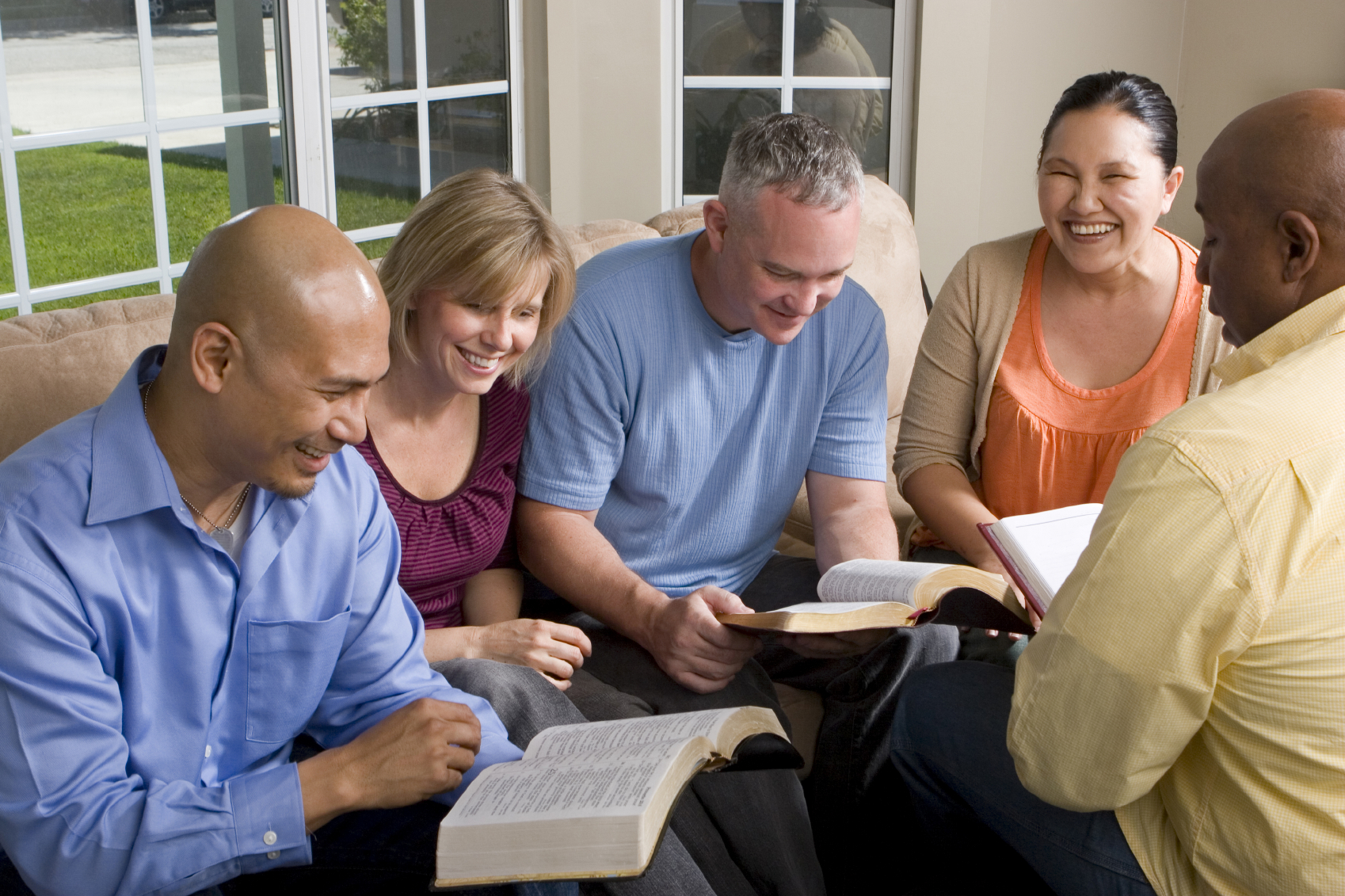 Protestants are delighted to have Catholics attend their Bible studies, but it is often not because they want to hear and discuss the Catholic perspective on Scritpure. Instead, they see it as an opportunity to bring them to the “true Gospel”—to evangelize them, to get them saved.
In many cases, though certainly not all, the non-denominational Bible study is the Trojan Horse that infiltrates the Catholic’s mind and succeeds in drawing him away from the one, holy, catholic and apostolic Church—to join a Protestant group. Most of us have a family member or friend who has been affected in this way.
An unwary Catholic who steps into the Protestant Bible study usually does so with no intention of leaving the Catholic Church. They just want to study the Bible. The Catholic usually has a hard time finding a good and welcoming Bible study in Catholic circles—but this is changing.
First, while the Bible study may call itself “non-denominational,” Catholics and Orthodox are not usually included under this umbrella. While they may be invited, you’ll rarely find them in leadership.
Protestants think of themselves as people of the Book, not hampered by human tradition. They think of Catholics as, at best, followers of traditions for whom the Bible is secondary.
That is a huge misconception: Protestants are also people of tradition. No one reads the Bible objectively. People who claim to “just read the Bible” really read it through the eyes of a tradition they’ve already accepted, whether that be Fundamentalist, Calvinist, Pentecostal, Baptist or one of many others. Everyone depends upon tradition, but not everyone recognizes it.
“Bible Christians,” based on their tradition, study the Bible with these premises:
- There is no binding authority but the Bible alone.
- There is no official binding interpretation or interpreter.
- The Bible is perspicuous (i.e., easy to understand) and can be interpreted and understood by anyone.
- An individual can and should read the Bible and interpret it for himself.
Catholics, based on their Tradition, study the Bible with different premises:
- The authority of the apostles and the Church preceded the Bible, and the Tradition of the Church is an equally infallible authority (2 Thess. 2:15; CCC 80–83). The Bible is part of the apostolic Tradition.
- The authoritative interpretation of the Bible is the prerogative of the Catholic Church (1 Tim. 3:15; Matt. 18:17; CCC 85-88).
- The Bible is not always easy to understand (2 Pet. 3:15-16) and needs to be understood within its historical and contextual framework and interpreted within the community to which it belongs.
- Individuals can and should read the Bible and interpret it for themselves—but within the framework of the Church’s authoritative teaching and not based on their own private interpretation (2 Pet 1:20-21).
These basic differences place the Catholic and Protestant worlds apart even though they are opening the pages of the same book and accepting it as an authoritative revelation from God. The Catholic position is biblical and has been espoused from the first days of the Church. The Protestant position is unbiblical and is of recent origin. The Catholic is in full continuity with historical Christianity; Protestants are in discontinuity.
Catholics attending a non-denominational Bible study need to be aware of these differences and be ready not only to filter out false conclusions but also to guard themselves against the false underlying assumptions (e.g., that everything has to be found and proven explicitly in the Bible).
Catholics who are unaware often begin to adopt a Protestant mentality without knowing they are doing so, gradually learning to suspect the Catholic Church and trying to prove everything from the Bible.
Let’s Take Just One Example: Baptism
But what difference do these premises make? Let’s take the example of 1 Peter 3:18-21:
For Christ also died for sins once for all, the righteous for the unrighteous, that he might bring us to God, being put to death in the flesh but made alive in the spirit; in which he went and preached to the spirits in prison, who formerly did not obey, when God’s patience waited in the days of Noah, during the building of the ark, in which a few, that is, eight persons, were saved through water. Baptism, which corresponds to this, now saves you, not as a removal of dirt from the body but as an appeal to God for a clear conscience, through the resurrection of Jesus Christ.
Notice the words in italics. What does it say? To Catholics it makes perfect sense because Christians have always taught (until the Reformation) that baptism is essential for salvation. As Catholics, we can draw from a wealth of other biblical and patristic passages that consistently and continuously teach a seamless garment of doctrine—the constant teaching of the Church, of all Christians.
A few examples:
Jesus answered, “Truly, truly, I say to you, unless one is born of water and the Spirit, he cannot enter into the kingdom of God.” (John 3:5)
This has always been understood to mean water baptism, until descendants of the Reformation denied it and came up with new interpretations, such as that the water refers to the water in the womb, the word of God, or even a synonym for the Spirit (as in “water, even the Spirit”). There is no consensus among Protestants.
Other examples are Acts 2:38 and Acts 22:16. The first says, “And Peter said to them, ‘Repent, and be baptized every one of you in the name of Jesus Christ for the forgiveness of your sins; and you shall receive the gift of the Holy Spirit.’”
The second one says, “And now why do you wait? Rise and be baptized, and wash away your sins, calling on his name.”
These verses agree with the words of Jesus, Titus 3:5, and the rest of the New Testament about the necessity and importance of baptism. But many Evangelicals will offer in reply a list of verses that say salvation is by faith (e.g., John 3:16) and argue that since he can find twenty-five verses that say salvation is by faith, it can’t be by baptism.
Can we cut two verses out of the Bible because we find ten others that seem to contradict? Heavens, no! We have to find a way to explain and accept both and harmonize them into a cogent theology. That is what Catholics have been doing well for two millenia.
One of the great reliefs for me as a Catholic was to read the Bible without having to set aside verses that didn’t agree with my preconceived assumptions. Catholics do not have this problem.
A Figure of a Figure? Go Figure.
Now, back to 1 Peter 3:18-21. Protestant commentaries on Scripture admit it is one of the most difficult passages of the Bible to interpret. Here is a quote from my book Crossing the Tiber:
In his recent anti-Catholic book The Gospel according to Rome, James McCarthy says that “when Peter says that ‘baptism now saves you,’ he is speaking of the typological, or symbolic, significance of baptism. . . . It [the word figure] tells us that what follows, ‘baptism now saves you,’ is a figurative illustration that complements the symbolism of a preceding figure” (331-332).
It seems he is saying that baptism is a figure of a figure instead of the fulfillment of a figure. A Greek-English Lexicon of the New Testament and other Early Christian Literature offers a different and more straightforward interpretation: “Baptism, which is a fulfillment (of the type), now saves you, i.e., the saving of Noah from the flood is a . . . ‘foreshadowing’ and baptism corresponds to it [fulfills it]” (75).
McCarthy does go on to say: “This verse is part of one of the most difficult passages in the New Testament to interpret. Nevertheless, this much is clear: it does not support the Roman Catholic doctrine” (331-332). (Crossing the Tiber, p. 130, note 56)
The Catholic interpretation explains the passage quite comfortably without twisting the text from its clear meaning, accepting the literal meaning of the text, and complementing the rest of New Testament teaching. It is difficult for McCarthy to interpret because he comes to the passage with a handicap: his Fundamentalist preconceptions.
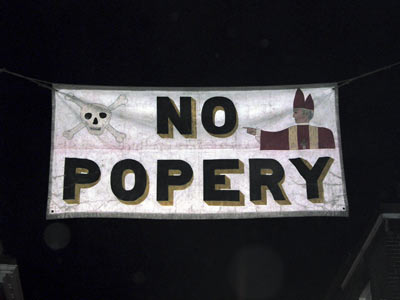 Catholics: Seen but Not Heard
Baptism is just one example, and we have only scratched the surface. Other examples of passages that are difficult for Evangelicals—and where unwary Catholics attending a non-denominational Bible study can be misled—are John 20:23, Colossians 1:24, James 2:24, Matthew 16:18-19, and John 5:28-29.
Catholics often find non-denominational Bible studies appealing because of the warm, serious, loving, and family-like environment. Being used to reverence and quiet devotion, Catholics find the welcoming and chatty nature of these gatherings refreshing and new.
But there is such a thing as an ecumenical Bible study that doesn’t allow knowledgeable Catholics to participate in leadership or where the Catholic perspective is not equally presented and discussed with respect. In a truly ecumenical Bible study, the Catholic interpretation and teaching is not treated as substandard or heretical.
Also, the Catholic Church is not a “denomination” (which means “to take a new name”); it is the Church. Those who are in schism, who break away or subsist apart from it are denominations or sects. The Church is not. It is the Church.
There’s still a long way to go to get Catholics to the point of scriptural study that Protestants have achieved. But it is happening, and you can help. For more information, see my article “Starting a Parish Bible Study” at www.catholicconvert.com.
Before Chapter and Verse
Chapter and verse divisions in the Bible are quite recent. They have proven quite helpful in biblical study and finding our way around. But they can also be a great hindrance if people begin to see the Bible as an unrelated collection of wise maxims listed numerically.
It becomes quite easy to pluck a numbered statement (a verse) out of its context and quote it as in independent entity. For the first 1,600 years of Christianity, biblical study was conducted without verse numbers, forcing the reader to see whole texts and not simply lists of unrelated sentences randomly compiled.
Cruise Day 5: All Day at Sea; Steve Ray’s “Seminar on St. Paul”
Two videos below: 1) Our day at Sea; 2) My full 1 1/2 hour seminar talk on St. Paul.
Everyone was looking forward to today because we’d be at sea all day and could enjoy the ship and get some rest. As we moved from Crete toward the island of Rhodes, we had blue skies and open horizons the whole way.
We had Sunday Mass aboard the ship, then I gave my 1 1/2-hour talk on “Life, Theology and Travels of St. Paul” to prepare everyone for the stops we’ll make along the way.